


the budget · what is agreedA wedding budget
that knows what is agreed, paid and still open.
How to budget for a wedding with three hundred guests and more than one celebration? Start with what is agreed, what is paid, and what is still to come.
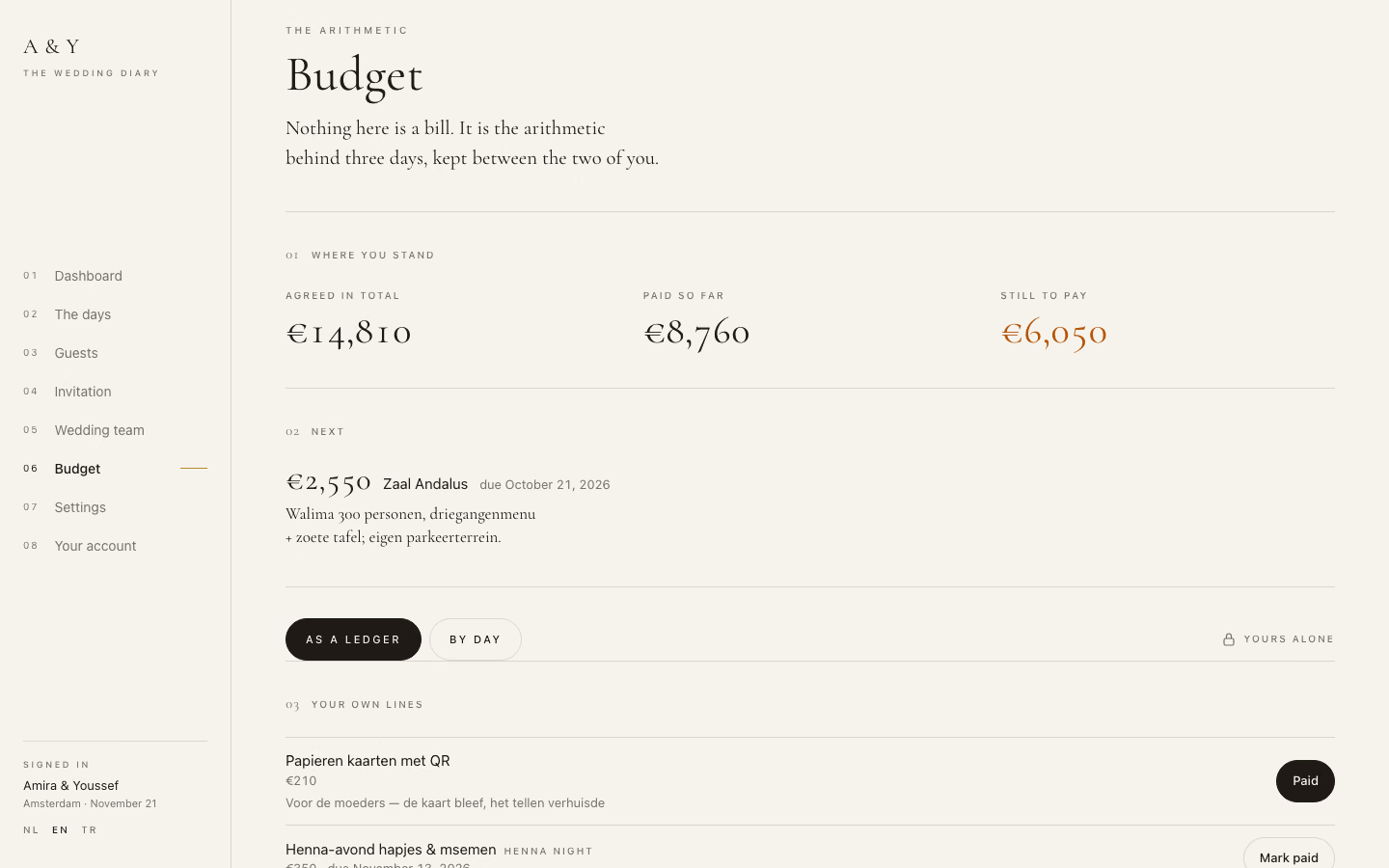
Every agreement with your wedding team and every line of your own, added up to agreed, paid and still to pay — beside what you expected — with what falls due, week by week.

three screens from the product
Example weddings · Amira & Youssef and Priya & Rahulwith more than one celebration
Per celebration, each adds up its own agreements.
Choose a celebration and the kına, the nikah and the düğün each show their own agreed, paid and still to pay. A line of your own is for one celebration or for the whole wedding; an agreement for more than one celebration is listed apart, because nothing says how much of it belongs to each.
who sees what
- You two
- Everything: the four figures, what falls due, every line.
- Your planner
- Nothing — until you choose: seeing the money, or changing it too, per person, each off until you turn it on.
- Your venue and your team
- Each business sees only what you agreed with it, on its own link: the lines, what is paid and what is still to pay. Never the rest of your budget.
the four figures
Expected.
Agreed. Paid. Still to pay.
Four figures that mean four different things. What you expected is your own estimate; agreed minus paid is always still to pay.
- You expected
- The one figure you set for the whole wedding, shown when you look at the whole wedding. Estimates on your own lines stand beside it until you commit them; then they count in the other three.
- Agreed
- Everything you agreed with your wedding team, plus the lines of your own that are settled.
- Paid
- Every deposit and every payment you entered, with its date.
- Still to pay
- The difference: what is agreed and not yet paid.
What falls due, week by week
Every payment in the week it is due — paid, part paid, due, or past its date — and what is planned with no date yet — with a button on a business’s instalment to give it one. On top, what the money still needs: a payment past its date, or more agreed than you expected.
two currencies
Side by side, or one total.
- Side by side
- A wedding in two countries often pays in two currencies. Each figure stands in its own currency, never added across them.
- One total
- Give the rate and the page also shows one total, with the rate you gave and the day you gave it.
Nothing is converted behind your back: one sum appears only when every rate it needs is yours.
your own lines
The dress, the rings, the favours.
Not everything has a supplier. What is not an agreement goes on a line of your own — an estimate while you are still guessing, committed once it is agreed — for one celebration or for the whole wedding.
- A name, an amount in its own currency, a date it is due and a date it was paid, and a private note.
- One celebration or the whole wedding — the line counts where it belongs.
- An estimate becomes committed once it is agreed; to make it an estimate again, clear its payment date first.
Your planner sees the amounts only if you say so
Seeing the money and changing it are two levels, set per person, each off until you turn it on — beside the numbers themselves, not tucked away in Settings.

You know what it costs.
And what it is for.
Expected, agreed, paid, still open: four figures, so the talk at the table can be about something else.
three questions
What people ask here.
Is the budget linked to my bank?
No. No bank link and no payments through us. You write down what you agree and pay; the budget adds it up.
Can we see one celebration’s money on its own?
Yes. Choose a celebration and its agreed, paid and still to pay stand on their own; an agreement for more than one celebration is listed apart.
Does my planner see the amounts?
Only if you let them: seeing the money and changing it are two switches per person, each off until you turn it on.
What it does not do
- No bank link and no payments through us: the budget writes down what you agree and pay, and does the arithmetic.
- Currencies are never added up for you: two stand side by side until you give the rate.
what we record
What we keep, and what we deliberately do not put beside it.
You see who opened their invitation and who has not yet. That is only possible if we keep something, so here is exactly what that is — and where it stops.
We do
- When the link was first opened.
- When it was last opened.
- How often.
- Roughly what kind of device it was.
- The language chosen.
- The answer.
We do not
- Where anyone is.
- A fingerprint of the browser.
- An advertising identifier.
What your venue and your team read is on a link of their own — it carries no guest list, and no amount but their own agreement.

The next chapter is yours
Let’s get you
to “I do.”
One page your guests open from WhatsApp, and behind it your list, the answers and the day plan. The free version: every celebration, up to 100 guests in all. Confirm your address and your diary opens straight away.
Confirm your address and your diary opens straight away.
the wedding diary
Your people. Your celebrations. One shared plan.