Skip to content

the wedding diary · guides · Things I wish I knew sooner

Multicultural wedding planning — 12 things I wish I knew before a wedding with more than one celebration

A sangeet and a wedding. A kına, a nikah and a düğün. A traditional ceremony and a white wedding a month later. The advice you find online is written for one day and one list, and the mistakes it does not warn you about are the ones that cost the most. Twelve of them, in the order they arrive: multicultural wedding planning as it actually goes.

By , editor · published · updated · 10 min read

A hand writing a list in an open notebook on a table, a cup of coffee beside it.
The first list is always on paper. The trouble starts when there are three of them. Photo: Katya Wolf · Pexels

01

Where this list comes from

This is not a survey and it is not a ranking. It is a checklist, written from the shape of wedding this diary was built for — several celebrations, often several languages, a guest list in the hundreds — and from the mistakes that shape produces again and again, whatever the tradition. A sangeet, the music night before an Indian wedding, and a kına gecesi, the Turkish henna night, are different evenings with the same problem: they have their own guests, and somebody has to count them.

The twelve are in the order they turn up. The first three arrive before you have booked anything. The next four are about people, and they are where most of the arguments live. Three are about the plan, two about money and paper, and the last one is the reason the other eleven are hard. Under each: what goes wrong, an example, and the one thing to do about it this week.

02

The days

  • 1. Every family counts the celebrations differently — A walima, the meal after a Muslim nikah, is a whole evening to one family and an afternoon tea to another. A Nigerian traditional wedding and the white wedding a month later are two weddings to the families and one to the couple. Nobody is wrong, and arguing about what counts wastes the weeks you need for booking. The way out is to stop counting and start listing: write every celebration down as a day of its own, with its own date, place and guest list, and let each family see its own days on the list. Do it this week, before the first venue call, because every venue will ask “which day?” and “how many?” and both answers come from that list. The diary is built on the same rule: each celebration is a day, with its own guests and its own answers.
  • 2. The rooms set the dates, not you — Three things on a wedding calendar are not yours to move. The register office gives you a slot, often the only one that month. The imam, the priest or the pandit gives you an hour, and on a Saturday in summer that hour is spoken for months ahead. The hall gives you an opening and a closing time, and both are in the contract. Everything else — the henna night, the photographs, the pick-up — is arranged around those three. Get them in writing first, then choose the movable things. A couple who books the hall first and then discovers the ceremony room has nothing that Saturday spends a week unpicking a deposit.
  • 3. Two celebrations in one weekend cost more than two in two — Not in money: in people. Put the henna night on Friday and the party on Saturday and the same forty relatives dress twice, travel twice and eat twice in thirty hours; the older ones will skip one, and it will be the one you wanted them at. A week between the two, where the tradition allows it, gives the family a rest and gives you a night’s sleep between the two rooms you have to fill. Where it does not — a three-day Hindustani wedding is three days by design — plan the middle day as the quiet one and say so to the guests.
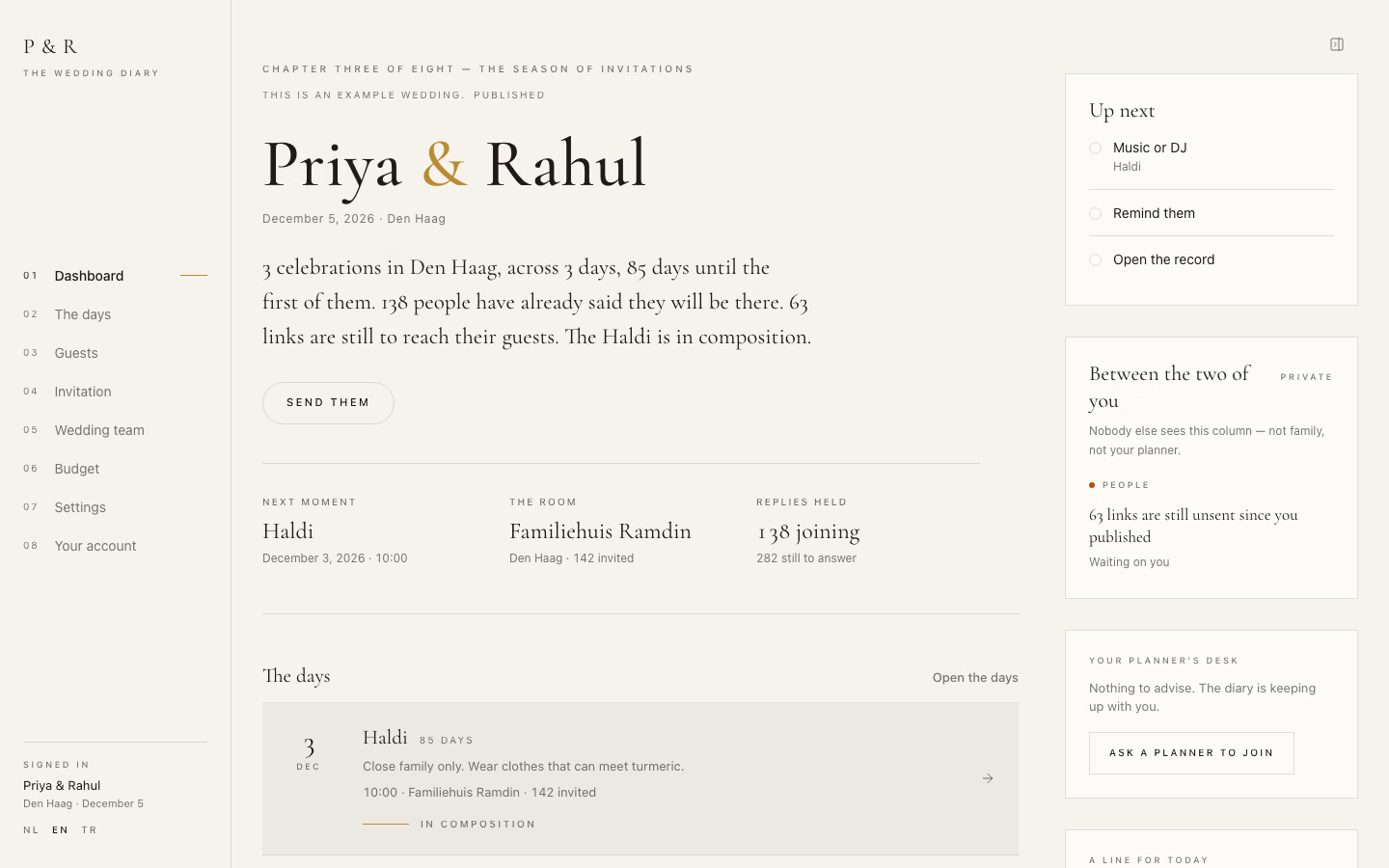
The first page of a wedding diary in the product: three celebrations across three days, the answers so far, the open tasks and the wedding team on one screen.
Example wedding Priya & Rahul — the first page of the diary, where the three days, the answers and the team sit together.

03

The people

  • 4. Three celebrations means three guest lists — Not one list with three ticks. Each list is bounded by something different: the henna night by a living room or a small hall, the ceremony by the chairs in the room where it happens, the party by the hall and the budget. Build the smallest first, then the middle one, then the largest — a couple who starts with the big list turns the henna night into a subtraction, and everyone taken off the big list notices. Sort people by group before you sort them by name, so that when the hall says three hundred and twenty and the list says three hundred and eighty you cut a group and not sixty individuals. The whole method, including the four cases that always tear, is in who to invite to which celebration.
  • 5. Count people, never invitations — An invitation goes to a household; a hall counts chairs. A hundred and twenty envelopes can be three hundred people, and “Aunt Nur and family” is four seats, not one. Keep one line per person from the first day, with the household as a grouping on top, and mark children as children — the hall will count them its own way, and a list that knows which lines are children can answer in a minute. The arithmetic of plus-ones, children and the head-count deadline is in 400 guests, no paper.
  • 6. Language belongs to the guest, not to the invitation — Your aunt reads Turkish, your colleague reads Dutch, the cousin in London reads English, and they all receive the same invitation. A language button at the top hands the work to the reader, and for an aunt of sixty-eight opening a link in WhatsApp that button is the reason she calls her daughter instead of answering. Decide per guest which language they read — by generation, not by surname, and ask whoever gave you the number — and fix it once. How to decide, and what to do with a household that reads two languages, is in one wedding, two languages.
  • 7. Give each mother a number before she gives you names — Cutting a list that has already been written is a conversation per name, and there are sixty of them. A list that starts with a limit is a list that fits. Say the number first — “the henna night is seventy, thirty-five from each side” — then ask for the names. Say the same number the same way to both mothers, and write the rule down rather than the decisions, so the next case is an application and not an argument.

04

The plan

  • 8. The map’s travel time is not your travel time — The map gives you one car leaving now. Your day has twelve people and a dress leaving in three cars on a Saturday afternoon, plus a quarter of an hour of getting in, plus parking and the walk from the car park to a town hall in the centre, plus a convoy that loses the first traffic light and then drives at the speed of the slowest car. Look the route up on the same weekday at the same hour, add the getting in at both ends, and start the clock when the last car leaves, not the first. Then decide which block absorbs a delay — usually the photographs — and say so to the photographer in advance. The route method, with what a venue needs a week before, is on the day plan itself, where the travel line sits under every stop.
  • 9. Your venue needs numbers, not names — The kitchen wants “six vegetarian, two without gluten, all halal”, not a list. The floor manager wants two arrival times: the couple’s and the guests’. The bar wants to know whether the wedding is dry. None of them wants your guest list, and a guest list is what makes them call you at nine in the evening. A week out, send one page per celebration — the head count and the date it closed, the arrival times, the moments the venue itself has to cue, who holds the microphone, your team with load-in times, diets and children as numbers, what you bring and who receives it, the end time and who clears — and then ask what is missing. The full page is what your venue needs from you a week out; the diary gives the venue a link of its own with the celebrations it works, the times and how many said yes to each — without guest names, and with no money but what you agreed with the venue itself.
  • 10. One person may say “we drop this”, and it is not the couple — Weather at an outdoor moment, a supplier who does not turn up, running late — the three things that happen at nearly every wedding with more than one stop. Write three fallback lines, each with four facts: what you will see, what you will do, who decides and by when. “Rain after four — ceremony inside, in the conservatory. Decided by Ayla, by two at the latest.” Give that person the plan, the phone numbers and the venue’s one contact, and tell the venue her name. The couple decides nothing on the day; that is what the day is for.
A couple at a kitchen table, looking at a laptop together, papers spread between them.
One place everyone reads beats three phones and a spreadsheet called final-final-v9. Photo: Ron Lach · Pexels

05

The money and the paper

  • 11. Three numbers, written down: agreed, paid, still to pay — Every supplier, every celebration, on one line each. A budget that lives in three phones is three budgets, and the number that matters — what is still to pay before the day — is the one nobody has. Write the agreed amount when you agree it, the payment when you make it, and let the third number be arithmetic. Keep the reason beside it: “deposit, hall, henna night”. The diary’s budget keeps those figures per celebration and for the whole wedding — the whole beside what you expected — and shows what falls due week by week.
  • 12. Keep it in one place, or someone else will keep it for you — The list ends up with whoever happens to be standing closest: a sister, a brother, a friend, on the phone, with four hundred names on paper and a spreadsheet called final-final-v9 in three inboxes. That is the reason the eleven points above are hard, and the reason this diary exists. One page your guests open from WhatsApp, and behind it your list, their answers per celebration, the day plan and the room — read by your partner and your planner from the same place, by your mother for the families you give her, and by the venue, its own part of it, from a link.

06

What to do this week

Write the celebrations down as separate days, in the order they happen. Ask the three rooms for their slots, in writing. Then start the smallest guest list, without looking at the other two, and give both mothers their number before you ask for a single name. Everything after that is arithmetic, and arithmetic is the easy part.

Frequently asked

How many celebrations count as “more than one”?
Two is enough. The moment a second evening has its own guests — a henna night with the women of the family, a reception a month after the ceremony — you have two lists, two rooms and two head counts, and every piece of advice written for one day starts to fail quietly.
Should every guest be invited to every celebration?
No, and nobody expects it. Parents, siblings and the cousins you speak to weekly go to all of them; colleagues and neighbours usually come to the big evening only. Decide by group, not by name, and say the reason out loud when a room is small.
How far in advance should we fix the dates?
As soon as you know which rooms you need. The register office, the imam or priest and the hall each hand you a slot, and everything else moves around those three. Choose the movable things last.
Do we need a wedding planner for several celebrations?
Not necessarily, but you need one person who is not the bride or the groom to hold the plan on the day. If you hire a planner, give her a door into the same plan rather than a copy of it.
Newlyweds walking out into a lakeside garden celebration, guests cheering at the edges

The next chapter is yours

Let’s get you
to “I do.”

One page your guests open from WhatsApp, and behind it your list, the answers and the day plan. The free version: every celebration, up to 100 guests in all. Confirm your address and your diary opens straight away.

Confirm your address and your diary opens straight away.

the wedding diary

Your people. Your celebrations. One shared plan.