Skip to content

the wedding diary · guides · Planning, digitally

The photography checklist for a wedding with three celebrations

A haldi in the morning, a ceremony at noon, a party until two. Or a henna night on Thursday and a nikah and düğün on Saturday. The photographer you hired shoots one day beautifully; nobody told her there are three, in four buildings, with two families who each want their formals. This wedding photography checklist: the shot list per day, the travel between stops, and the two families’ portraits — written down so the pictures you actually want exist.

By , editor · published · updated · 6 min read

Close-up of a photographer’s hands holding a camera during a wedding, the couple out of focus behind.
One person sees the whole day through a viewfinder. She needs the plan more than anyone. Photo: Nguyễn Tiến Thịnh · Pexels

01

Why one shot list is not enough

A photographer plans a wedding day around the light and the moments that happen once: the first look, the walk in, the ring, the first dance. A wedding with three celebrations has three sets of those, in three kinds of light, in different buildings, sometimes in different cities. A haldi — the turmeric ceremony the morning of an Indian wedding — happens in a courtyard at ten; a kına gecesi, the Turkish henna night, happens in a hall at nine in the evening under coloured light. The same lens will not do both.

This checklist is built from what a photographer needs before every day and rarely gets: where, when, who, in which light, and how long to the next stop. It is written from the photographer’s side of the camera, because that is the side where the pictures you want either exist or do not.
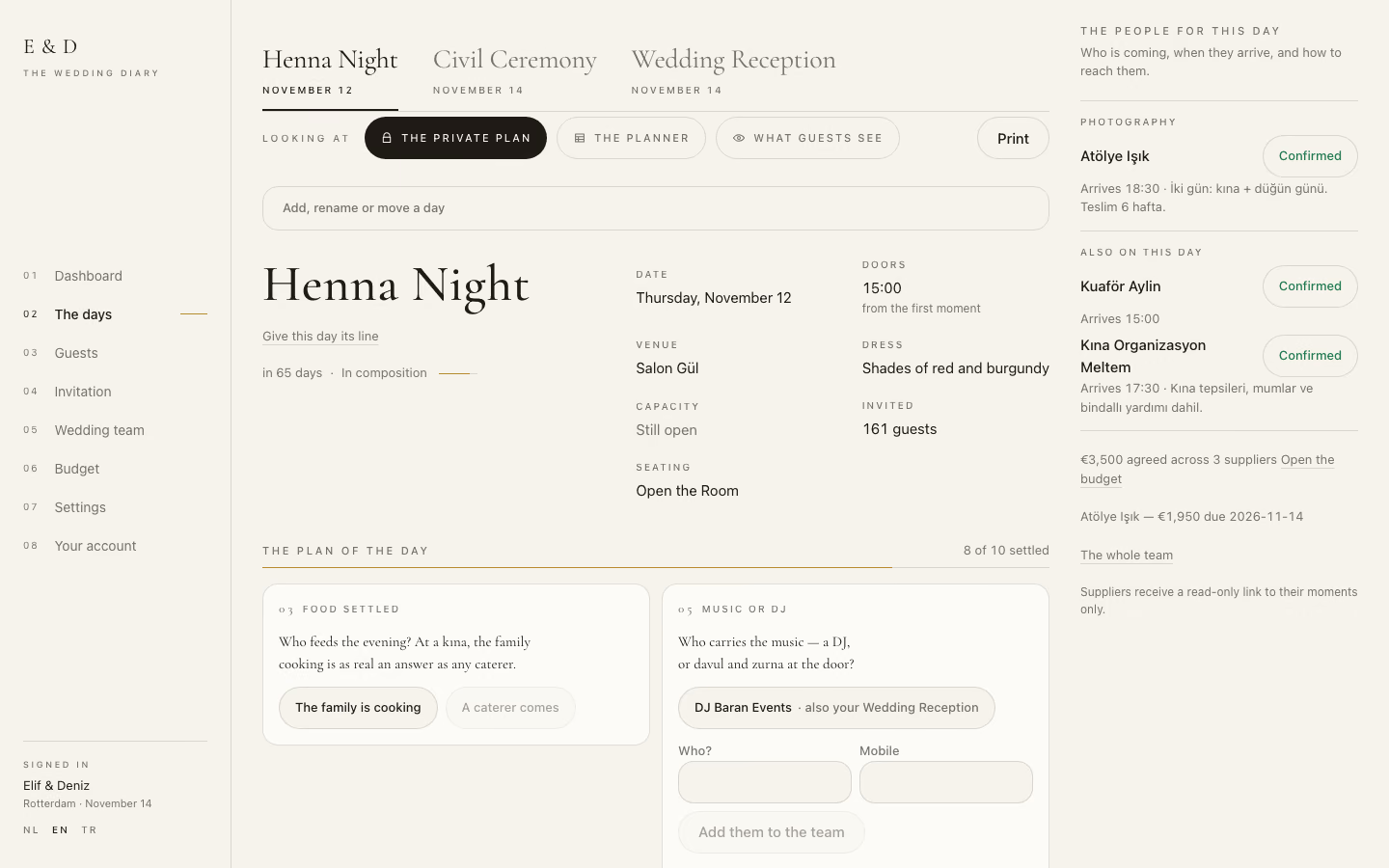
The day plan in the product, with the three celebrations as tabs and, for the henna evening, the date, the doors, the venue, the number invited and the team booked for that day.
Example wedding Elif & Deniz — the day plan per celebration, with the people for that day beside it. Each business reads a link with its own moments in full and the rest of the day as a time, a title and a place.

02

One brief per celebration

Send each day as its own brief. Five lines are enough.

  • The room and the light — Indoors or out, day or evening, and what the room looks like when it is full. A hall with a mirrored ceiling and a chandelier is a different job from a garden at six.
  • The moments that happen once — The henna being applied, the veil, the baraat (the groom’s procession to the venue in an Indian wedding), the takı (the moment gold and money are pinned to the couple at a Turkish wedding), the cake, the exit. One line each, with an approximate time, so she is not at the bar when it happens.
  • The people who must be in the pictures — Grandparents first. Then the people who are only at this celebration and no other: the aunt who cannot do evenings, the colleague who is only at the ceremony.
  • The dress code and the colours — Not for her, for the background: red and gold on a red wall needs a different plan from ivory in a white hall.
  • Travel to the next stop — The photographer travels too, and usually in the last car. If the couple leaves at four and the photographer at ten past, she arrives after the walk-in she was hired to shoot.

03

The getting-ready hour

For most couples the getting-ready is the one set of pictures they wish they had planned: the mother fastening a necklace, the sisters in the doorway, the last quiet minute. It is also the one hour that cannot be redone, because it is over the moment you leave the house.

Write it into the plan with a start time and an address, and decide who is in the room. Two people getting ready in two houses is the first place a second photographer earns her fee.

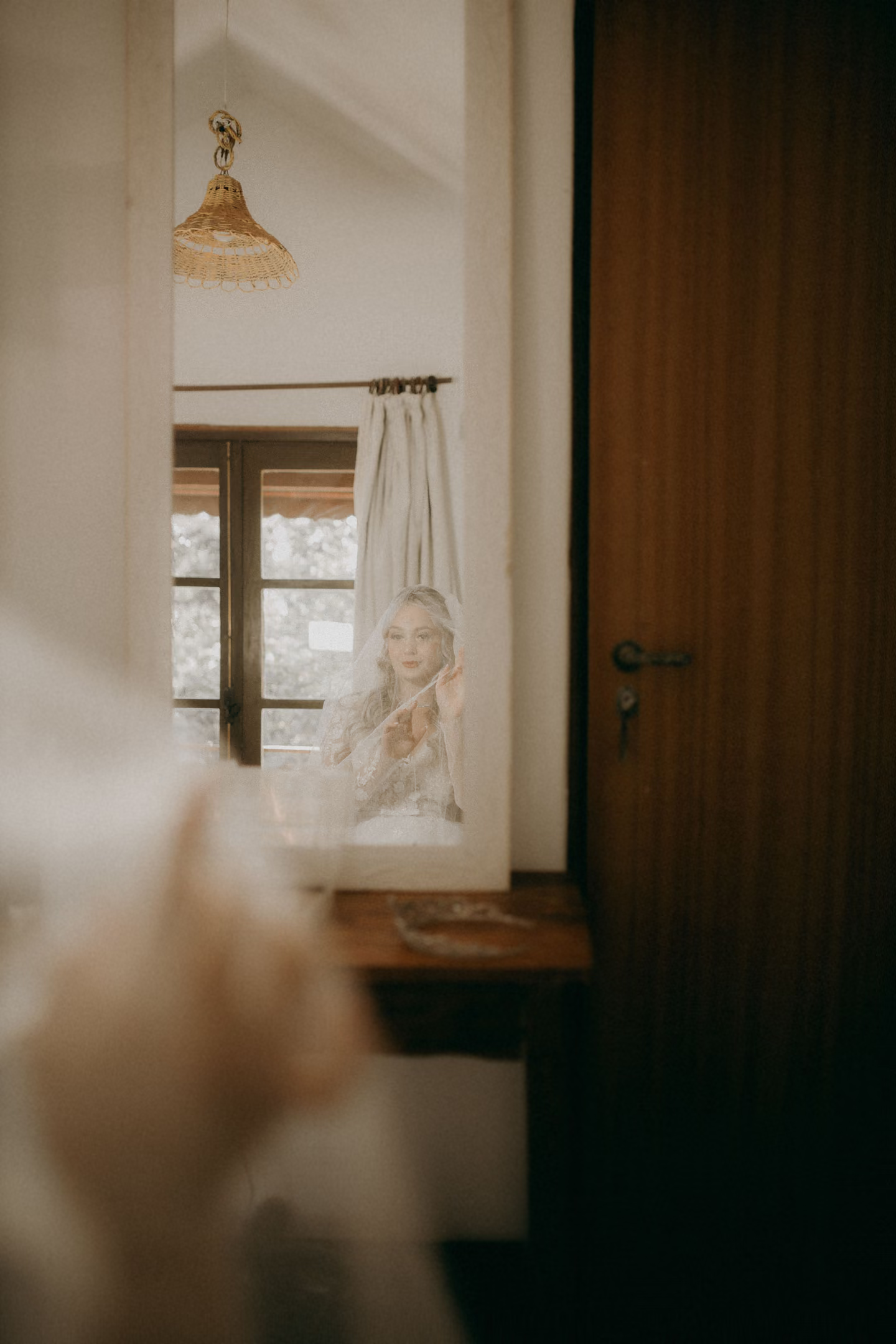
A bride seen in a mirror while getting ready in a quiet room, morning light from a window.
The getting-ready is the one hour the photographer cannot redo. Put it in the plan with a time. Photo: Alexander Mass · Pexels

04

The family formals, by name

The family portraits take longer than any other single thing on a wedding day, and they take longest when nobody wrote down who is in them. Both families want their own set; the older relatives can stand for one round, not three.

Write the groups down, by name, in the order you will call them, starting with the people who should sit down soonest. A workable list has eight to twelve groups. Give it to the photographer and to one person from each family who knows every face in it; the photographer does not.

Decide where the formals happen per celebration. After the ceremony, in the light outside the building, is usually right; at the party, before the guests sit down, is usually right; at the henna night, a single group with everyone, and then let her work.

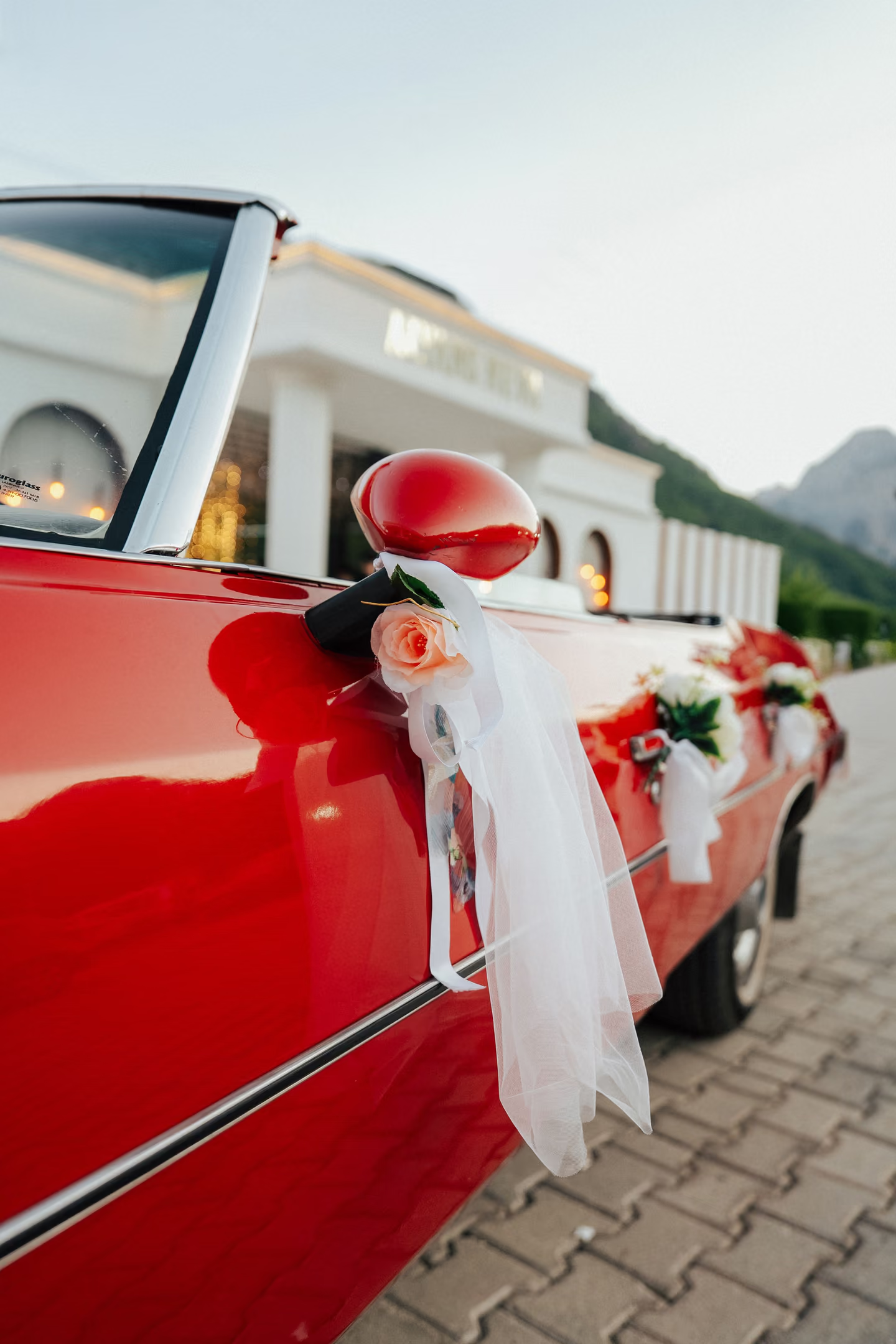
A wedding car decorated with ribbon and flowers, parked in a street.
Every stop is a car ride, and every car ride is time the photographer is not shooting. Photo: Samet Tecimen · Pexels

05

The travel between stops

The map gives you one car leaving now. Your day has twelve people and a dress leaving in three cars on a Saturday afternoon, and the photographer in the last of them. The full method for the route, with what the venue needs a week out, is on the day plan itself, where each stop carries the travel time to the next.

  • Look up the route at the same weekday and hour — Saturday at four is not Tuesday at four.
  • Add the getting in and the parking — A quarter of an hour at each end, more at a town hall in a city centre.
  • A convoy is slower than a car — Cars that want to stay together lose the first traffic light and then drive at the pace of the slowest.
  • Decide which block absorbs a delay — Usually the photographs. Say so in advance, so she plans a short version of the formals and a long one.

06

Give her the plan, not a copy of it

A plan changes on Tuesday. The PDF you sent on Sunday does not, and that is the version in her bag on the day. The diary gives each business on your wedding team a link of its own: it opens only the celebrations that business works, with the moments you share with it and what you agreed with it, no guest list, and it changes when the plan changes. Give the photographer hers the day you book her; a second shooter from another business gets a link of their own.

On the day itself, print one copy anyway, for the person who watches the clock. A phone at seven percent is not a plan.

Frequently asked

How do I brief a photographer for several celebrations?
One brief per celebration, each with the venue, the light, the moments that happen once, the people who must be in the pictures, and the travel time to the next stop. Send it a week out, then walk through it on the phone. A single brief for the whole wedding is where the henna night gets lost.
How long do the family portraits take?
Count three to four minutes per group and write the groups down by name — both families, in the order the older relatives can stand for. Ten groups is half an hour, and half an hour has to exist in the plan.
Do we need a second photographer?
When two things happen at once you do: the bride and the groom getting ready in two houses, or the guests arriving while the couple is still at the ceremony. Ask your photographer; she knows which day needs a second pair of eyes.
Should the photographer see the day plan?
Yes, and the live one. A plan that changes on Tuesday and reaches her as a PDF from Sunday is the one where she is at the wrong door. Give her a link that always shows the current plan.

Related guides

Newlyweds walking out into a lakeside garden celebration, guests cheering at the edges

The next chapter is yours

Let’s get you
to “I do.”

One page your guests open from WhatsApp, and behind it your list, the answers and the day plan. The free version: every celebration, up to 100 guests in all. Confirm your address and your diary opens straight away.

Confirm your address and your diary opens straight away.

the wedding diary

Your people. Your celebrations. One shared plan.